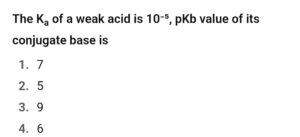
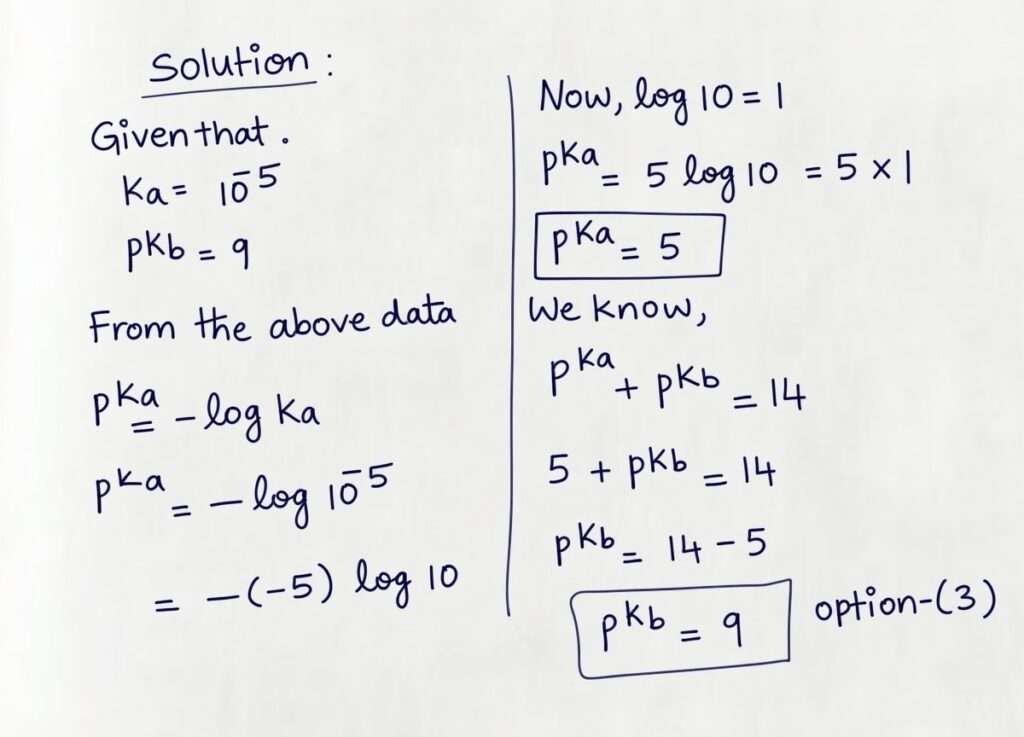
Video solution:
dissociation constant of acid (Ka) : It is a measure of the extent to which an acid dissociates in solution. The less an acid dissociates, the smaller the value of Ka. The stronger the acid, higher will be the value of Ka.
What is a Conjugate Acid-Base Pair?
Every acid has a conjugate base- the species left after the acid donates a proton (H⁺). For a general weak acid HA:
HA ⇌ H⁺ + A⁻
(acid) (conjugate base)
The strength of the acid and its conjugate base are inversely related:
- Stronger acid → weaker conjugate base
- Weaker acid → stronger conjugate base Since this acid is weak (Ka = 10⁻⁵), its conjugate base A⁻ will be a relatively strong base compared to the conjugate bases of strong acids (which are extremely weak/neutral).
- Key Relationship: Ka, Kb, and Kw In aqueous solutions at 25°C, the ion product of water is:
- Kw = [H⁺][OH⁻] = 1 × 10⁻¹⁴
-
For any conjugate acid-base pair, this important equation holds:
Ka × Kb = Kw = 10⁻¹⁴
Here:
- Ka is the acid dissociation constant of HA
- Kb is the base dissociation constant of the conjugate base A⁻
So, we can directly calculate Kb:
Kb = Kw / Ka = 10⁻¹⁴ / 10⁻⁵ = 10⁻¹⁴ × 10⁵ = 10⁻⁹
-
do you know what is pKa?
Ka (acid dissociation constant) measures how much a weak acid HA dissociates in water:
HA ⇌ H⁺ + A⁻ Ka = [H⁺][A⁻] / [HA]
Ka is usually very small (like 10⁻⁵ or 10⁻⁴), so scientists use pKa for convenience:
pKa = -log₁₀(Ka)
- Lower pKa → stronger acid (dissociates more → larger Ka)
- Higher pKa → weaker acid
-
Example:
- Acetic acid (CH₃COOH): Ka ≈ 1.8 × 10⁻⁵ → pKa ≈ 4.74(weak acid).
- Hydrofluoric acid (HF): Ka ≈ 6.8 × 10⁻⁴ → pKa ≈ 3.17(strong acid).
pKa tells us directly: the acid with smaller pKa value is stronger.
-
What do you know about pKb?
Similarly, for a weak base B:
B + H₂O ⇌ BH⁺ + OH⁻ Kb = [BH⁺][OH⁻] / [B]
pKb = -log₁₀(Kb)
- Lower pKb → stronger base (larger Kb)
- Higher pKb → weaker base
Example:
- Ammonia (NH₃): Kb ≈ 1.8 × 10⁻⁵ → pKb ≈ 4.74(weak base)
- Methylamine (CH₃NH₂): Kb larger → pKb smaller (stronger base)